
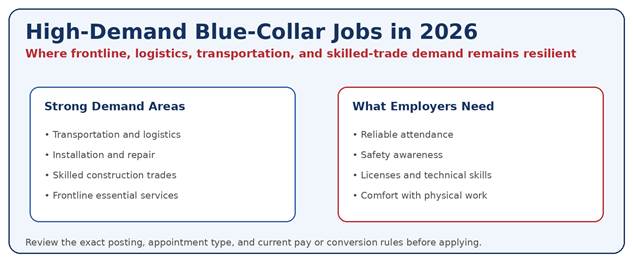
Why Blue-Collar Careers Stand Out in 2026
The U.S. labor market is slower in 2026, but employers still struggle to fill many frontline, transportation, logistics, construction, and skilled-trade roles. These jobs depend on physical operations that cannot be moved entirely online, and many require workers to be present at a facility, jobsite, route, or customer location.
Demand is not equal across every occupation. Routine warehouse work is becoming more automated, while employers continue to report shortages in licensed driving, maintenance, electrical work, construction supervision, installation, repair, logistics, and other roles that combine practical skills with safety and reliability.
1. Transportation and Logistics
Transportation and logistics remain central to supply chains. Forbes identified transportation, logistics, and essential services as a resilient hiring area for 2026. Truck drivers and CDL drivers also appear among positions employers struggle to fill quickly, reflecting persistent licensing and labor-supply constraints.
Postal processing and distribution work sits inside the same broader physical economy. Workers sort, scan, move, stage, and route mail and packages on fixed operational deadlines.
A Mail Processing Clerk role provides an example of this work. Review the shift, lifting requirements, sorting duties, facility environment, and appointment status before app.
2. Electricians and Electrical Trades
Electrical work remains difficult to automate because it requires field diagnosis, code knowledge, installation judgment, and hands-on work in changing environments. Demand is supported by data centers, grid upgrades, building electrification, manufacturing investment, and replacement of retiring workers. Entry routes often include apprenticeships, technical school, or employer-sponsored training rather than a four-year degree.
3. HVAC, Industrial Maintenance, and Repair
Heating, ventilation, refrigeration, industrial maintenance, and equipment-repair jobs remain practical options for workers who want technical careers. Modern facilities depend on conveyors, motors, controls, HVAC systems, vehicles, and automated equipment. As automation expands, the need shifts toward workers who install, troubleshoot, and maintain machines.
4. Construction and Skilled Trades
Construction hiring varies by region and interest rates, but skilled workers remain difficult to replace. Electricians, plumbers, welders, heavy-equipment operators, estimators, superintendents, and specialized installers often benefit from experience that is learned on the job. Employers value safety records, certifications, reliability, and the ability to work independently.
5. Delivery, Postal, and Essential-Service Work
Essential-service jobs have a different demand profile from discretionary office hiring. Mail, parcels, utilities, repairs, transportation, and field services still need workers even when companies reduce junior corporate hiring. These roles may involve early starts, weekends, weather exposure, lifting, and strict productivity standards.
Broader Job Openings help job seekers compare postal, logistics, technical, and other occupations, but the strongest opportunities usually come from matching your current skills with an employer that has a clear shortage.
What Makes a Blue-Collar Job High Demand?
- Employers cannot easily move the work offshore or make it fully remote.
- Licensing, certifications, or physical skills limit the qualified applicant pool.
- The occupation serves essential infrastructure or supply-chain needs.
- Experienced workers are retiring faster than replacements enter the field.
- The role requires hands-on judgment that automation does not fully replace.
- Turnover is high enough that employers recruit continuously.
Skills That Increase Your Hiring Odds
|
Skill |
Why It Matters |
Where It Helps |
|
Safe equipment handling |
Reduces injury and damage risk |
Warehouses, postal plants, construction |
|
Mechanical troubleshooting |
Supports automated operations |
Maintenance, HVAC, manufacturing |
|
Commercial driving |
Licensing creates a smaller talent pool |
Trucking, delivery, logistics |
|
Reliability and attendance |
Frontline work depends on coverage |
Postal, logistics, field services |
|
Digital scanning and inventory tools |
Physical work increasingly uses software |
Warehousing, fulfillment, postal processing |
|
Customer communication |
Many field roles interact with the public |
Delivery, utilities, installation, repair |
Are Warehouse Jobs Still High Demand?
Some warehouse employers continue to hire heavily, but the job mix is changing. Robotics and automated storage systems reduce certain repetitive tasks while increasing demand for technicians, supervisors, equipment operators, maintenance workers, and employees who can work with digital warehouse systems. A job seeker should look for roles that add technical responsibility rather than re only on manual picking or packing.
Why Postal Processing Still Fits the Blue-Collar Market
Postal processing combines physical handling with scanners, sorting equipment, safety procedures, and strict dispatch times. The work is local, operational, and tied to a national delivery network. It is a useful option for applicants who prefer structured shift work over office-based entry roles.
External Labor-Market Reference
For a broader view of resilient hiring areas, review Forbes’ Where the Jobs Are in 2026. It identifies transportation, logistics, and essential services as areas where employers continue to need workers.
Frequently Asked Questions
What blue-collar fields are strong in 2026?
Transportation, logistics, skilled construction trades, installation, repair, maintenance, and essential frontline services remain resilient in many markets.
Do high-demand blue-collar jobs require college?
Many do not require a four-year degree. Apprenticeships, licenses, certificates, technical school, and on-the-job experience often matter more.
Is automation eliminating warehouse work?
Automation is changing warehouse work more than eliminating it. Routine tasks face pressure, while maintenance, equipment, supervision, and technical logistics roles gain importance.
Are postal jobs considered blue-collar work?
Many operational postal roles fit the category because they involve physical handling, delivery, sorting, equipment, routes, facilities, and shift-based work.
What is the fastest way to become more competitive?
Build one concrete skill employers screen for, such as a CDL, electrical credential, forklift certification where appropriate, mechanical troubleshooting, or documented safety experience.
Should I apply to jobs marked high demand even without direct experience?
Apply when you meet the minimum requirements and can show transferable skills. Reliability, physical stamina, customer service, safety awareness, and equipment experience often transfer across frontline industries.
Final Takeaway
High-demand blue-collar work in 2026 is concentrated where employers need people on-site, skills are hard to replace, and operations cannot stop. Logistics, transportation, maintenance, skilled trades, and essential services remain strong areas to watch. Focus on roles that build technical responsibility, credentials, and experience that remain useful even as automation changes routine tasks.